Vesuvius Challenge
The Vesuvius Challenge is one of the most interesting, complex, and fun AI challenges I’ve encountered. In 2023, I worked with the team conducting the challenge during its initial months, focusing on segmenting CT scans of scrolls. REAL SCROLLS. ~2,000 YEARS OLD.
In 2024, I returned to the challenge independently, this time working towards ink detection on digitally flattened scroll surfaces.
The Process
It begins in the lab, where high-resolution X-ray CT scans capture the inside of a scroll. The reconstructed 3D volumes contain thousands of cross-sectional slices, depending on the scan’s resolution and extent. These are the publicly available datasets that researchers can work with.
Segmentation methods trace the papyrus surfaces through the volume. Those surfaces are then digitally flattened, and nearby scan data is sampled into stacks of slices called surface volumes. Ink-detection models use these stacks to predict where ink may be present.
The output depends on the scan, the segmentation, the surface rendering, the training labels, and the model itself. Errors at one stage can carry through to the next. The real process is far more intricate than this short explanation can capture, which is part of what makes it so fascinating.
What I explored
My experiments included training 3D ResNet models from scratch on exposed scroll fragments and fine-tuning publicly available pretrained checkpoints, including Youssef Nader’s community ResNet3D model for 3 µm data. I also explored training and fine-tuning TimeSformer models, alongside iterative labeling: reviewing predictions, refining ink labels, and using those labels in subsequent training.
The submission shown here
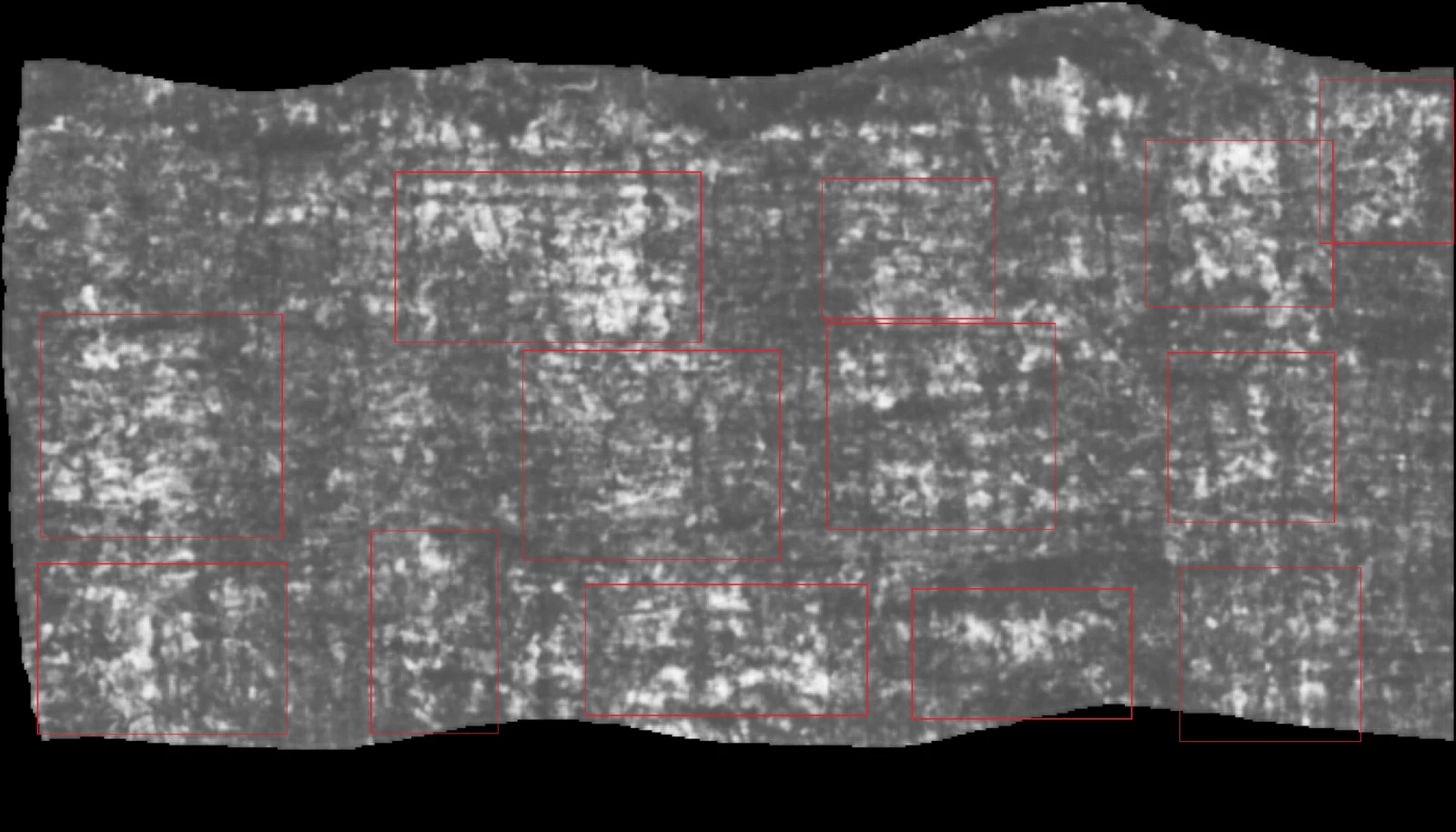
For this submission, I initially fine-tuned the community ResNet3D checkpoint on Fragment 5’s exposed surface, then worked with the first-quarter crop of Scroll 4 segment 20231111135340, identified in my submission as 20231111135345. I used a Colab notebook with an ink label and mask, running on an L4 or A100 GPU through Colab Pro.
The later training run was limited to a few epochs by time constraints. I inspected letter-like forms in the crop and compared their scale with those on Fragment 5. The annotated image records those exploratory observations, with further iterative labeling needed to develop the experiment.