Multimodal processing & Evals
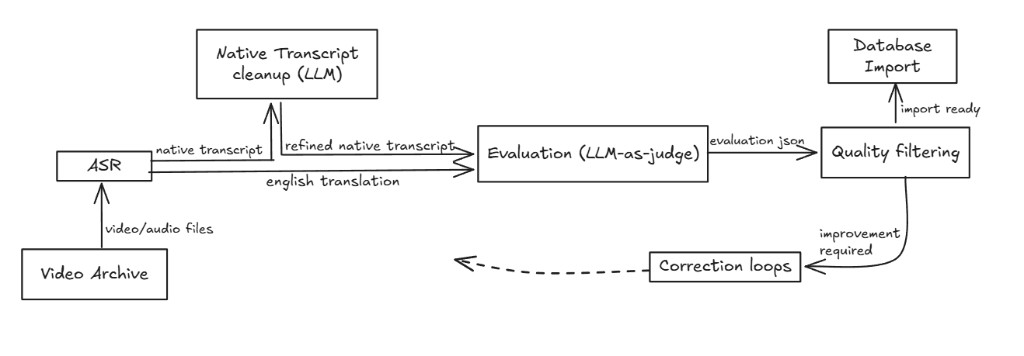
I worked on a project with a US-based media-tech organization that manages a large archive of citizen video interviews in multiple Indian languages, and they needed a way to turn thousands of these videos into usable text for research and archiving. At first glance, it seemed like a straightforward ASR + translation problem, but it wasn’t.
The audio was often messy, dialect-heavy, and had multiple speakers, so basic transcription and translation pipelines produced outputs that looked fine on the surface but were actually unreliable. Moreover, those were incapable of handling longer videos.
Instead of just processing the data, we built a multi-step system that also refines and judges its own outputs, evaluating transcripts and translations across multiple dimensions, identifying where things went wrong, and deciding whether to accept, fix, or re-run parts of the pipeline. Over time, this evolved into a feedback-driven system that doesn’t just generate text, but actively reasons about its quality, making it possible to scale while still maintaining trust in the data and minimize hallucinations.